
On this page
- How the two types differ
- Where they struggle around Kent
- When they make sense
- Fixing them properly
- Cost
- Choosing between a screen and a cover
- Screen types
- How covers behave in long rain
- Upgrading later
- Screen and cover details: common questions in Kent
- Where around Kent this comes up
- A quick check before calling
- Screen questions: common questions in Kent
- Notes by community
- What to note for the contractor
How the two types differ
| Term | What it means on a Kent-area house |
|---|---|
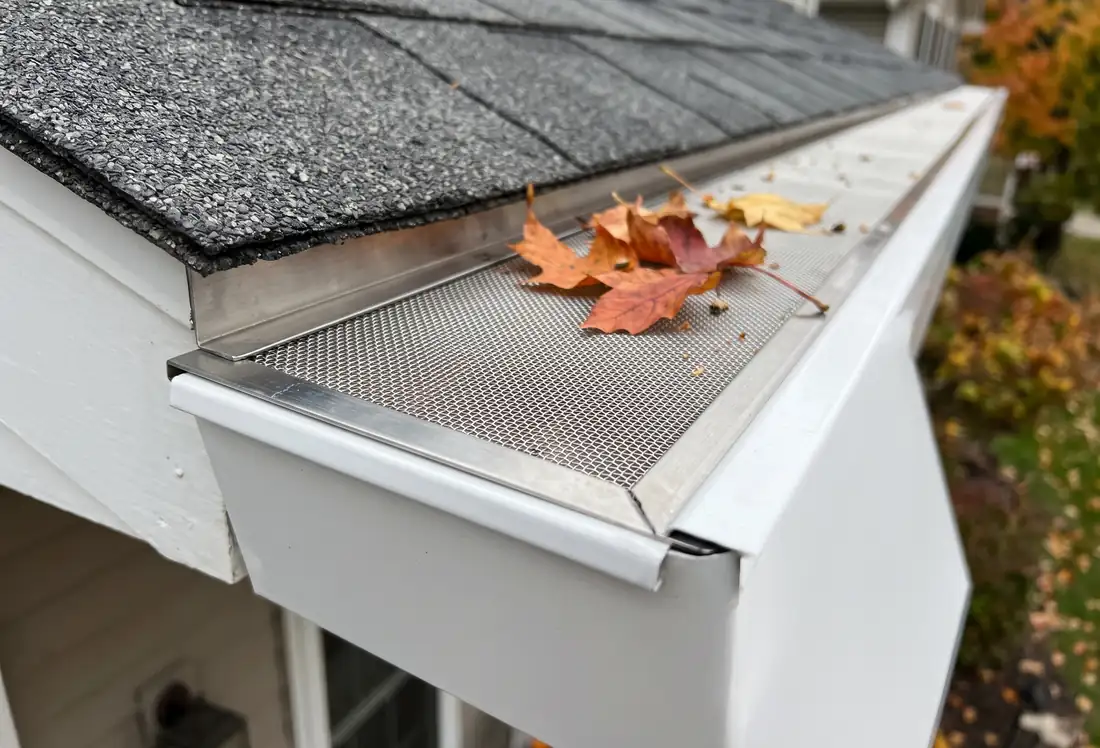
| Screen guard | A perforated panel that keeps whole leaves out but lets smaller debris and needles pass. |
| Reverse-curve guard | A solid cover that rolls water around its nose into the gutter while leaves slide off. Moss and needles can collect at its nose. |
| Screen | Reverse-curve cover | |
|---|---|---|
| Stops broad leaves | Yes | Yes |
| Stops conifer needles | Poorly | Partly |
| Handles moss | Poorly | Moss collects at the nose |
| Heavy rain | Good when clean | Can overshoot on steep roofs |
| Visibility | Low | Visible from the ground |
| Typical cost | Lower | Higher |
Where they struggle around Kent
Conifer needles are the main problem: they are thin enough to slip through screen holes and stiff enough to stand upright in the trough, catching more debris. Moss breaks off shaded roofs and gathers wherever water slows, including at the nose of a cover. With rain on about 150 days a year at the Kent station, anything that slows water at the gutter edge gets plenty of chances to clog.
When they make sense
- Only broadleaf trees nearby, such as maples or alders.
- Steep roofs where leaves slide off.
- Tight budgets, as a step up from no guard.
- Houses where cleaning is easy and the guard is just to reduce it.
Fixing them properly
Screens should be screwed to the gutter lip, not just snapped in, so windstorms cannot lift them. Covers must be set at the right angle for the roof. Either way, clean and repair the gutters before fitting.
Cost
Screens are the cheapest guard type; covers cost more. National ranges from This Old House give an idea. Compare with micro-mesh if any conifers overhang.
Choosing between a screen and a cover
Start with what falls on the roof. If the closest trees are big-leaf maples or alders, and the roof is steep enough for leaves to slide, a good screen may keep the trough clear with a brushing or two a year. If there are conifers anywhere near the eaves, neither screens nor covers are a reliable answer, because needles slip through holes and gather at the nose of a cover. In that case micro-mesh is the better spend.
| Trees near the roof | Screen | Reverse-curve cover | Micro-mesh |
|---|---|---|---|
| Big-leaf broadleaf only | Good | Good | Good |
| Mixed broadleaf and conifers | Poor | Fair | Best |
| Mostly conifers | Poor | Poor | Best |
| Shaded roof with moss | Poor | Poor | Good with brushing |
Screen types
Screens come as perforated aluminum, expanded metal, or plastic grids. Rigid metal screens screwed to the gutter lip last longest and stay put in windstorms. Plastic grids are cheap but sag and become brittle. Snap-in screens that rely on tension alone can be dislodged by wind or by snow sliding off the roof.
How covers behave in long rain
A reverse-curve cover depends on water following the curve of its nose into a slot. In steady rain on a moderate roof, that works. On steep roofs, fast-moving water can leap the curve, and in a climate with rain on about 150 days a year, needles and moss collecting at the slot gradually reduce how much water gets in.
Upgrading later
If screens or covers are already fitted and needles are getting past, they can usually be removed and replaced with mesh. Ask the contractor to check the gutters and hangers at the same time.
Screen and cover details: common questions in Kent
| Question | Short answer |
|---|---|
| Do screens need cleaning? | Yes; leaves settle on top and small debris passes through to the trough. |
| Can a reverse-curve cover go on existing gutters? | Some systems fit existing gutters; others come as a combined unit. |
| Do covers work on steep roofs? | Water can overshoot the curve in heavy rain on steep roofs. |
| Are screens cheaper than mesh? | Yes, usually much cheaper. |
| Can screens be upgraded later? | Yes; they can be removed and replaced with mesh. |
Where around Kent this comes up
| Community | Why it comes up there |
|---|---|
| Downtown Kent | Homes with broadleaf street trees |
| Federal Way | Varied lots across the city |
| SeaTac | Older homes with mixed trees |
A quick check before calling
Check whether any conifers stand within reach of the roof. If so, skip screens and price micro-mesh.
Screen questions: common questions in Kent
| Question | Short answer |
|---|---|
| Do covers hide the gutter? | Yes, covers are visible as a smooth hood over the gutter. |
| Can screens handle snow? | Rigid screens can; flimsy ones sag. |
| Are plastic screens any good? | They are cheap but become brittle and sag. |
| Will screens stop cones? | Yes, most cones stay on top. |
Notes by community
| Community | Why it comes up there |
|---|---|
| East Hill | Ramblers under maples |
| Federal Way | Varied tree cover |
| Downtown Kent | Street trees |
What to note for the contractor
Ask whether the screen is screwed down or snapped in. Screwed is better in windstorms.