
On this page
- Covington at a glance
- What shapes gutter work in Covington?
- Targeted upgrades
- HOA rules
- What gutter setup suits houses in Covington?
- How does the Kent climate play out in Covington?
- How much gutter does a typical Covington house need?
- Which gutter problems come up most in Covington?
- Streets, parks and landmarks in and around Covington
- How should gutters be sized in Covington?
- What tells you a Covington gutter needs attention?
- What happens when a contractor visits?
- What is worth noting before you call?
- Nearby areas
Covington at a glance
| County | King County (Wikipedia) |
| Founded | 1900, at a Northern Pacific Railway stop |
| Incorporated | August 31, 1997 |
| Population | 20,777 at the 2020 census, up from 13,783 in 2000 |
| Neighbors | Kent to the west, Maple Valley to the east |
| Housing | 7,149 housing units in 2020 |
What shapes gutter work in Covington?
Covington began in 1900 at a Northern Pacific Railway stop on land once called Jenkins Prairie. A lumber mill operated by 1908, and dairies replaced lumber by the 1920s. It grew into a suburban bedroom community late in the 20th century, incorporated on August 31, 1997, and reached 20,777 residents in 2020, up 18.2 percent from 2010. It borders Kent to the west and Maple Valley to the east.
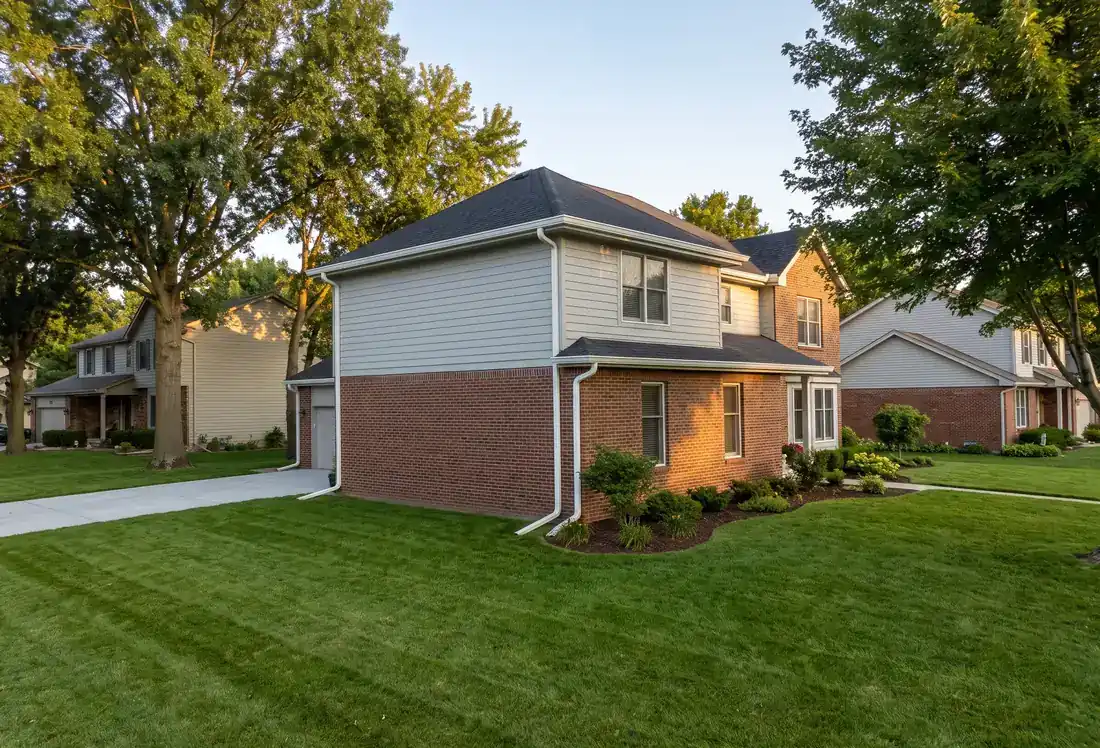
Much of the housing is newer two-story construction. Those homes were typically finished with builder-grade gutters, often 5-inch in thin coil with 2x3 downspouts. Long rear eaves and valleys can overwhelm them through the wet season, and thin coil dents easily.
Targeted upgrades
Many owners start with the problem spots: 3x4 downspouts, an extra outlet on long runs, 6-inch gutters on the worst eaves, and micro-mesh where lots back onto trees.
HOA rules
Some neighborhoods have homeowners associations with rules on exterior colors. Check before changing gutter color.
What gutter setup suits houses in Covington?
Covington's newer two-story homes usually need targeted upgrades rather than a full tear-out.
| Typical choice in Covington | |
|---|---|
| Gutter | 6-inch on long two-story eaves; keep 5-inch where it copes |
| Metal | .032 aluminum |
| Downspouts | 3x4 |
| Fastening | Hidden hangers about every 2 feet |
| Guards | Micro-mesh where lots back onto trees |
| Cleaning | September and December |
| Discharge | Extensions or drains away from foundations |
| Main risks | Undersized builder systems, thin coil |
| Rules | Washington contractor registration; HOA color rules |
How does the Kent climate play out in Covington?
The 1991 to 2020 normals for the Kent station, as listed on Wikipedia, average about 40.1 inches of precipitation a year, spread over roughly 150 days with measurable rain. November is the wettest month at about 6.2 inches and July the driest at under 0.7. That is a different pattern from the cloudbursts of other regions: Puget Sound rain tends to arrive as long, steady storms from October to March, so gutters spend months carrying water and any clog, low spot or leaking joint runs for days at a time. Here is how a typical gutter year runs.
| Months | What it means for gutters in Covington |
|---|---|
| October | The rains return, about 4 inches on average; broadleaf leaves join the year-round needle fall |
| November to January | The wettest stretch: November near 6.2 inches, December and January near 5.8 each |
| February and March | Still wet, about 4 to 4.4 inches a month; needles, cones and moss pack outlets; windstorms drop branches |
| April to June | Rain tapers from about 3 inches to under 2; seeds and pollen add to the needles on guards |
| July to September | The driest months, under an inch in July and August; the best window for repairs and replacement |
How much gutter does a typical Covington house need?
Gutter is priced by the foot, so the length of the eaves drives most of the cost. These rows multiply typical eave lengths for local houses by national installed ranges from Angi. They show scale, not a quote.
| House | Typical eave length | Gutter | National range installed |
|---|---|---|---|
| Rambler | 120 to 160 ft | 5-inch seamless aluminum | about $1,080 to $2,080 |
| Two-story home | 180 to 240 ft | 6-inch seamless aluminum | about $2,160 to $4,320 |
| Large two-story home | 220 to 280 ft | 6-inch seamless aluminum | about $2,640 to $5,040 |
| Townhouse | 40 to 70 ft | 5-inch seamless aluminum | about $360 to $910 |
Removing the old system, replacing rotten fascia, adding downspouts or underground drains, guards and awkward access all add to these figures.
Which gutter problems come up most in Covington?
| House | What goes wrong | Usual fix |
|---|---|---|
| Two-story | Rear eave overflowing | 6-inch gutter; 3x4 downspouts |
| Two-story | Thin gutters dented | Replace with .032 coil |
| Home backing onto trees | Needles in gutters | Micro-mesh guards |
| Any home | 2x3 downspouts clogging | Upsize to 3x4 |
| Any home | Water by foundation | Extensions |
Streets, parks and landmarks in and around Covington
- Northern Pacific Railway: Covington began at its stop in 1900
- Pipe Lake: In Covington and Maple Valley
- Kent: Neighboring city to the west
- Maple Valley: Neighboring city to the east
How should gutters be sized in Covington?
Size follows the roof area that drains into each run and how hard it can rain, not the square footage of the house. A long winter storm keeps gutters running for hours, and needles and moss narrow the outlets, so the outlets and downspouts usually set the limit before the gutter does. A 5-inch K-style gutter with 2x3 downspouts suits a modest single-story roof. Long two-story eaves, steep pitches, valleys that concentrate water onto one corner, and upper roofs that dump onto lower ones are where 6-inch gutters and 3x4 downspouts earn their keep. Hidden hangers about every 2 feet into sound wood keep a gutter level under the weight of wet needles, snow and ice.
What tells you a Covington gutter needs attention?
- Water spilling over the front edge in an ordinary winter rain.
- Seedlings or grass growing in the gutter.
- A run that dips between hangers or pulls away at the ends.
- Peeling paint, stains or soft wood on fascia and soffit.
- Mud splashed up the siding or mulch washed out of the beds below an eave.
- Moss growing along the roof edge or in the gutter.
- A damp or musty crawl space after a wet week.
What happens when a contractor visits?
The contractor walks each gutter run, checks the fascia and soffit for rot, looks at the roof edge and drip edge, and follows every downspout to where it discharges. They explain what they found and give their own written quote, often with choices: repair, partial replacement or a new system. Nothing is agreed over the phone; you decide once the quote is in your hands.
What is worth noting before you call?
- Which side of the house has the problem, and whether it happens in every rain or only in downpours.
- How many stories, and whether there are porches, dormers or additions with their own small roofs.
- Large trees within reach of the roof, and which kinds.
- Photos of any storm or limb damage, with the date.