
On this page
What does a new installation include?
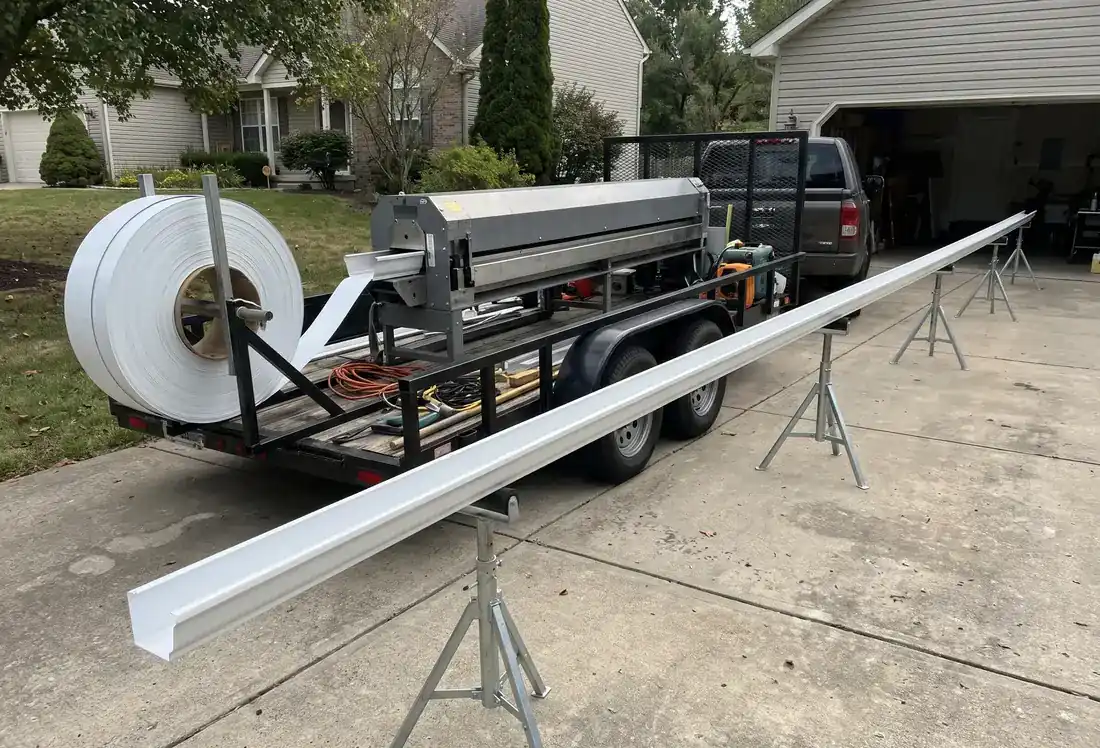
The work runs from the roof edge to wherever the water leaves the property. The old gutters, spikes and downspouts come down. The fascia is checked along every eave, and soft or mildewed boards are cut out and replaced. Each run is measured and formed in one piece on a seamless machine in the driveway, then pitched toward its outlet and hung on hidden hangers screwed into solid wood. Corners and end caps are riveted and sealed, outlets are cut, and downspouts are strapped to the wall and finished with elbows and an extension, splash block or connection to a drain.
Two things shape that work around Kent. The first is duration. The Kent station averages about 40.1 inches of precipitation a year over roughly 150 days with measurable rain, with November near 6.2 inches. Gutters here are less often overwhelmed by a single cloudburst than worn down by months of steady flow, so joints, slope and hanger spacing matter as much as size. The second is debris: where conifers overhang the roof, needles, cones and moss build up all year and narrow the outlets just when the wet season starts.
Which installation types are available?
| Type | Where it fits around Kent | Page |
|---|---|---|
| Seamless aluminum K-style | Most ramblers, split-levels and newer homes | Seamless gutters |
| 6-inch K-style | Two-story eaves, steep roofs, valleys | 6-inch gutters |
| Heavier aluminum | Houses under tall trees or snow slides | Aluminum gutters |
| Half-round | Older and craftsman-style houses | Half-round gutters |
| Copper | Accents on entries and older homes | Copper gutters |
| Downspouts and drainage | Every house | Downspouts |
How should gutters be sized for Kent rain?
Sizing starts with the roof area that drains into each run, adjusted for pitch. Then it allows for the heaviest rain the roof will see. Puget Sound storms are usually steady rather than violent, but long winter storms still bring hours of hard rain, and a valley can pour a concentrated stream onto one corner. Outlets narrowed by needles and moss make the real capacity lower than the gutter's size suggests.
| Roof situation | Usual gutter | Usual downspout |
|---|---|---|
| Single-story rambler, moderate pitch | 5-inch K-style | 2x3 or 3x4, every 30 to 40 feet |
| Two-story home, long eaves | 6-inch K-style | 3x4 |
| Steep roof or valley onto a corner | 6-inch K-style | 3x4 at that corner |
| Split-level with stacked roofs | 5 or 6-inch | 3x4 on lower runs that take upper water |
| Heavy conifer cover | Either, with mesh guards | 3x4 to resist clogs |
Downspouts are often the limit. Adding one, or moving to 3x4, can stop overflow without a bigger gutter. The 5-inch vs 6-inch guide goes into the detail.
Which metal should you choose?
| Term | What it means on a Kent-area house |
|---|---|
| Gauge | The thickness of the gutter metal. .027 inch aluminum is common on builder installs; .032 inch resists dents from limbs, ladders and snow slides better. |
| Galvalume | Steel with an aluminum-zinc coating. Stiffer than aluminum against limbs and snow, but cut edges need protecting from rust. |
| Patina | The brown-to-green layer copper forms as it weathers. It protects the metal beneath. |
Aluminum is the default: it does not rust, takes a baked-on color and forms easily on seamless machines. Ask for .032 inch coil where tall trees overhang or snow slides off the roof, because thinner builder coil dents. Steel is stiffer against falling branches but must have scratches and cut edges protected in a damp climate. Copper costs several times more and suits entries and older homes. The metals guide compares them.
How are gutters fixed to the house?
Many older gutters around Kent hang on spikes and ferrules, long nails driven through the gutter into the fascia. Wood that stays damp through the winter and dries in summer lets those spikes work loose, and the gutter starts to lean. New installations use hidden hangers that clip under the front lip and screw through the back into the fascia, usually about every 2 feet and closer at corners and under heavy trees. Screws hold far better in a windstorm, and when a gutter fills with wet needles or snow.
The wood matters as much as the hanger. A contractor should probe the fascia before hanging anything, replace soft boards, and ideally wrap new fascia in aluminum trim so it needs no paint.
Where does the water go?
| Term | What it means on a Kent-area house |
|---|---|
| Downspout extension | A length of pipe that carries water several feet out before releasing it, past the foundation and the backfill. |
| Underground drain | Buried solid pipe from the downspout to an approved outlet, with a cleanout so clogs can be flushed. |
| Pop-up emitter | A lid at the end of an underground drain that lifts to release water and drops shut when the flow stops. |
| Crawl space | The space under many older Puget Sound houses. Downspouts emptying beside the wall keep crawl spaces damp through the wet season. |
| Grading | The slope of the ground around the house. Soil should fall away from the walls so gutter water does not come back. |
The aim is to release water several feet from the house onto ground that falls away, or into an approved drain. Extensions and splash blocks do that cheaply. Underground drains carry it further but need solid pipe, steady fall and a cleanout. On hillside lots, the water has to be carried somewhere that will not wash out a slope or flood a neighbor. Keep leaves and grass out of street drains: the City of Kent has asked residents to help clear storm drains before heavy rain to prevent street flooding. The drainage guide covers the options.
What should a written quote include?
| Item | Why it matters |
|---|---|
| Gutter size and profile | 5 or 6-inch, K-style or half-round |
| Metal and thickness | Aluminum .027 or .032, steel or copper |
| Color | Matched to trim, siding or roof |
| Hanger type and spacing | Hidden hangers, about 2 feet apart |
| Downspout size, count and positions | 2x3 or 3x4, and where each one goes |
| Discharge | Extensions, splash blocks or drain connections |
| Fascia repair | A unit price so extra boards are predictable |
| Removal and haul-away | Included or not |
| Guards | Type and brand, if any |
When is new installation the right call?
When sectional gutters leak at joints all round, when spikes are pulling out along most runs, when the gutters spill in every long storm because they are too small, or when fascia repair means they must come down anyway. The repair or replace guide sets out the trade-offs, and gutter replacement covers swapping an old system out.