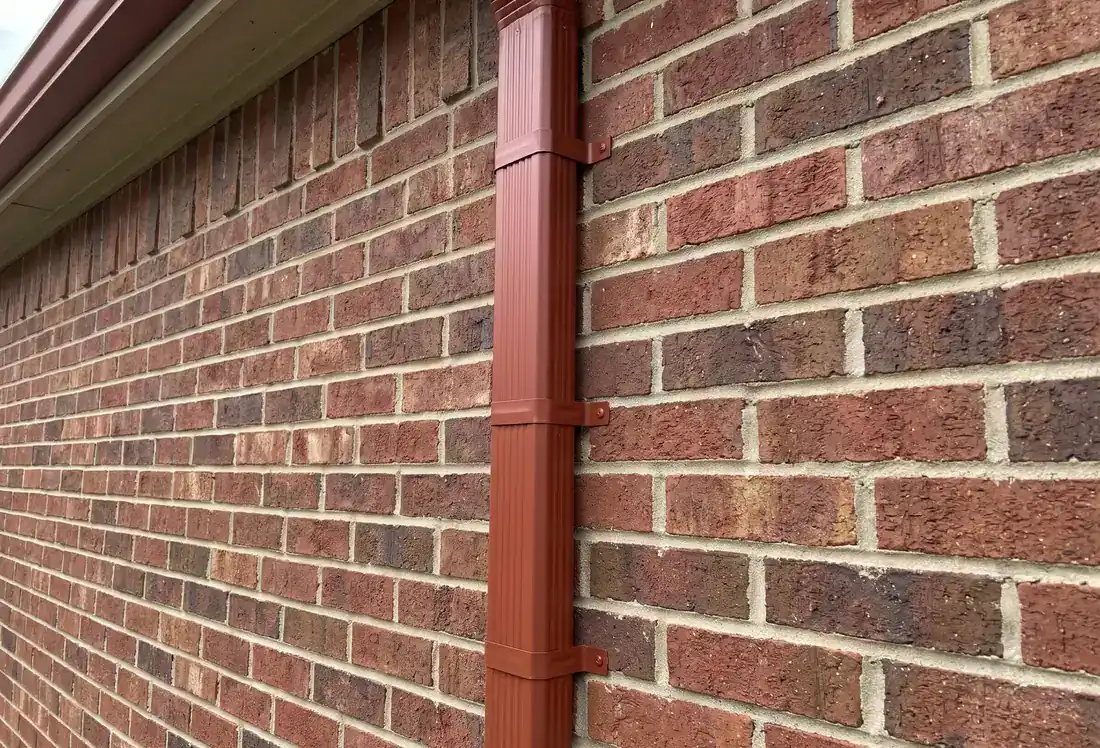
Downspouts decide how fast a gutter can empty and where the water ends up. Around Kent, where rain falls on about 150 days a year, a downspout that dumps beside the foundation feeds water to the crawl space all winter.
The Kent station averages about 40.1 inches of precipitation a year, most between October and March. That water arrives at the downspouts day after day. Too few downspouts, or ones that clog with needles, and the gutter spills; downspouts that empty beside the wall soak the soil there for months, which ends up in crawl spaces and under slabs.
Sizes
Term
What it means on a Kent-area house
Downspout
The pipe that carries water from the gutter to the ground. 3x4 inch carries roughly twice what a 2x3 does and clogs less.
Outlet
The opening in the gutter bottom where the downspout connects. Small outlets limit how fast a gutter can empty.
Elbow
The bends at the top and bottom of a downspout, where needles, cones, moss and twigs jam first.
Size
Carries
Best for
2x3 inch
Baseline
Small roofs, short runs
3x4 inch
About twice 2x3
Most houses; trees overhead
3 or 4-inch round
Similar to rectangular
Half-round systems
Where downspouts go
At each end of long runs, or one in the middle.
Near corners fed by valleys.
Away from entry steps, decks and driveways where water could pool or freeze.
Where the discharge can be carried downhill and away from the house.
Discharge options
Term
What it means on a Kent-area house
Downspout extension
A length of pipe that carries water several feet out before releasing it, past the foundation and the backfill.
Splash block
A concrete or plastic tray under a downspout that spreads the water and stops it digging a hole.
Underground drain
Buried solid pipe from the downspout to an approved outlet, with a cleanout so clogs can be flushed.
Option
Best for
Watch for
Extension
Most lots
Mowing, trip hazard
Splash block
Short distances on good grade
Not enough on flat or inward-sloping ground
Underground drain
Tidy yards, long distances
Solid pipe, fall, cleanout, approved outlet
Rain barrel
Garden use
Overflow must be routed away
On hillside lots on East Hill and West Hill, water should not be dumped at the top of a slope, where it can wash soil out. Keep debris out of street drains; the City of Kent asks residents to help keep storm drains clear.
Common upgrades
Upsizing 2x3 to 3x4 under conifers.
Adding a downspout at a valley corner.
Extending discharge past beds and backfill.
Adding a cleanout to an underground connection.
Planning downspout positions
Consideration
Why
One per 30 to 40 feet of gutter
Keeps runs from overloading
Near valley corners
Concentrated flow leaves fast
Away from doors and steps
Avoids pooling and ice
Downhill sides on slopes
Easier to carry water away
Hidden corners
Less visible
Clear of decks and patios
Avoids splashing
Color and visibility
Downspouts are most visible part of a gutter system from the street. Matching them to the wall behind, rather than the gutter, makes them disappear.
Downspouts: common questions in Kent
Question
Short answer
Can a downspout go through a deck?
It can be routed under or around a deck with elbows and offsets, but the joints must stay accessible for clearing, and water should still discharge well beyond the deck.
Do downspouts need guards at the bottom?
Near driveways and walkways a sturdy downspout or a guard at the base prevents crushing. A leaf strainer at the top keeps needles out.
Should every downspout go underground?
Not necessarily. Extensions and splash blocks work well where the ground slopes away. Underground drains suit long distances and tidy yards.
What color should downspouts be?
Usually the color of the wall behind them, so they disappear, rather than the gutter color.
How long do downspouts last?
Aluminum downspouts commonly last as long as the gutters if they are not crushed or left clogged.
Flat valley-floor lots where water has nowhere to run
A quick check before calling
Walk around the house in a steady rain and note where each downspout empties and where that water goes next. Photos of any pooling or washouts help the contractor plan positions.
Downspout options: common questions in Kent
Question
Short answer
Can downspouts be hidden?
Placing them at inside corners and matching wall color helps.
Are wider downspouts noisier?
Slightly; most owners do not notice.
Do downspouts need leaf strainers?
Strainers at the outlet help on houses without guards.
Can a downspout run to a rain garden?
Yes, if the rain garden is sized and placed away from foundations.